How to Accept Compliments Without Feeling Awkward

Compliments can land like a spotlight: flattering, but oddly uncomfortable. The good news is that feeling weird about praise is common—and changeable. With a few mindset shifts and simple response tools, compliments can become moments of connection instead of tension, helping confidence grow in a way that feels natural rather than performative.
Why compliments can feel so uncomfortable
Awkwardness around praise often has less to do with the compliment itself and more to do with what your brain does next.
- Cognitive dissonance: Praise can feel “bigger” than your current self-image, creating a mismatch that your mind tries to resolve by downplaying it.
- Fear of appearing arrogant: Many people were taught that accepting praise equals bragging, so they reflexively swat it away.
- Perfectionism: If the standard is flawless, anything less can make a compliment feel “undeserved.”
- Social uncertainty: Not knowing the “right” response can trigger overthinking and awkward scripts.
- Past experiences: If praise came with strings attached (teasing, criticism, pressure), your nervous system may treat compliments as unsafe.
What accepting a compliment actually signals
Receiving praise gracefully isn’t a personality trait you either have or don’t have—it’s a social skill that can be practiced.
- It shows presence: You’re acknowledging the other person’s experience without arguing with it.
- It’s not a claim of superiority: A simple “thank you” doesn’t mean “I’m better than others.” It means “I received what you offered.”
- It strengthens connection: Compliment-givers often feel good when their words are accepted; it’s a small moment of mutual warmth.
- It builds confidence through repetition: Each calm acceptance becomes evidence that praise is survivable—and sometimes even enjoyable.
If your self-esteem feels shaky, it can help to remember that self-esteem is not a fixed object; it’s influenced by experiences, beliefs, and reinforcement over time (see the American Psychological Association definition of self-esteem).
The most common cringe responses (and why they backfire)
Many “polite” reactions actually increase discomfort long-term by teaching your brain that praise is something to escape.
- Automatic denial: “No, it was nothing.” This can invalidate the giver and reinforce your own self-doubt.
- Self-deprecation: “I look terrible, actually.” This often turns the moment into reassurance-seeking and shifts emotional labor onto the other person.
- Deflecting to others: “It was all my team.” Sometimes appropriate, but as a habit it erases your contribution and can sound like you don’t believe the compliment.
- Over-explaining: “Thanks, I had three drafts and barely slept.” Extra details can signal discomfort and invite judgment or follow-up questions you didn’t want.
- Rapid return-compliments: “You too!!!” When used as an escape hatch, it can feel transactional instead of genuine.
A simple mindset reset: accept, don’t assess
Compliments don’t have to become a debate about whether you “deserve” them. Try treating praise as information about someone’s experience, not a courtroom verdict about your worth.
- Receive rather than evaluate: The goal is presence, not proof.
- Swap the question: Replace “Do I deserve this?” with “Can I allow this moment to be kind?”
- Practice micro-acceptance: Let the words land for one breath before responding.
If your body reacts with stress (blushing, racing heart, tight chest), a quick grounding breath can help. Mindfulness-based approaches are widely used for stress regulation (see Harvard Health on mindfulness and stress).
Plug-and-play responses for real life
When you’re unsure what to say, use a simple structure: Thank + Name what it means + Optional detail. If your nerves are high, keep it short; longer answers often signal anxiety and invite more scrutiny.
Compliment scenarios and responses that feel natural
| Situation | Simple response | Response with connection | When to add a detail |
|---|---|---|---|
| Appearance/style | “Thank you.” | “Thank you—so nice of you to say.” | Add if genuine: “I was trying something new today.” |
| Work performance | “Thanks, I appreciate that.” | “Thanks—glad it helped.” | Add credit appropriately: “I collaborated with Alex on the final pass.” |
| Personality/character | “Thank you, that means a lot.” | “Thank you—I’ve been working on that.” | Add if comfortable: “I’m trying to be more patient lately.” |
| Skill/talent | “Thanks!” | “Thanks—I’ve put a lot of practice into it.” | Add a small tip if asked: “What helped was doing it in short daily sessions.” |
| From someone you don’t trust | “Thanks.” | “Thanks—got it.” | Skip details; keep it neutral and brief. |
How to stop the nervous laugh, blush spiral, or freeze response
Your body can react to praise like it’s a threat. The goal isn’t to never feel activated—it’s to have a reliable next step.
For ongoing stress patterns, basic coping tools like sleep, movement, and supportive connection make these moments easier to handle (see the National Institute of Mental Health on caring for your mental health).
When a compliment feels loaded: boundaries without awkwardness
Practice plan: build confidence in 7 days
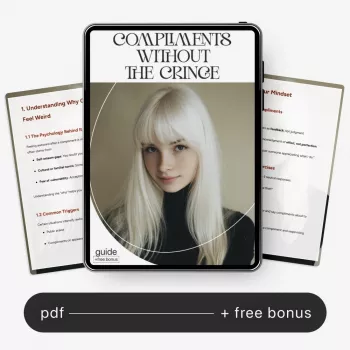
How to choose a compliments-and-confidence guide that actually helps
FAQ
What is the best response to a compliment if accepting praise feels awkward?
Use a short default like “Thank you” or “Thank you, I appreciate that,” then stop. Take one breath before you speak and avoid adding denial or a long explanation.
Is it rude to disagree with a compliment?
Direct denial can unintentionally dismiss the giver’s perspective. If it feels untrue, accept the kindness (“Thank you”) and move on, or offer a gentle reframe without self-criticism.
How do you respond to compliments that feel uncomfortable or inappropriate?
Keep it neutral and brief (“Thanks”), then change the topic. If needed, set a clear boundary such as “I prefer not to talk about that,” especially at work or in situations that affect your safety.








Leave a comment